The AI That Teaches Cooking

An AI that learns a head restaurant's signature cooking and teaches it in the kitchen. Where we are now, and how it works.

Technical terms are marked with a red *. Tap one to jump to “Tech Terms, in Plain Words” at the bottom of the page, then use your Back button to return to where you were reading.

On This Page
  1. Current Progress
  2. Vision & Technical Moat
  3. Teaching Beyond Human Limits
  4. Technology Protected by Patent
  5. A Solidly Built System
  6. Tech Terms, in Plain Words

01 Current Progress

The cooking AI we are developing isn't a someday idea. It's a system we are building stage by stage, right now. The hardest core technology is already finished, and the system's framework stands on top of it. This isn't a demo or a prototype made for show. It is in-depth development with one aim: making it actually work in real kitchens.

So far, the system as a whole has reached about 85% of the complete version. The rest of the way is laid out in the stages below.

Already complete

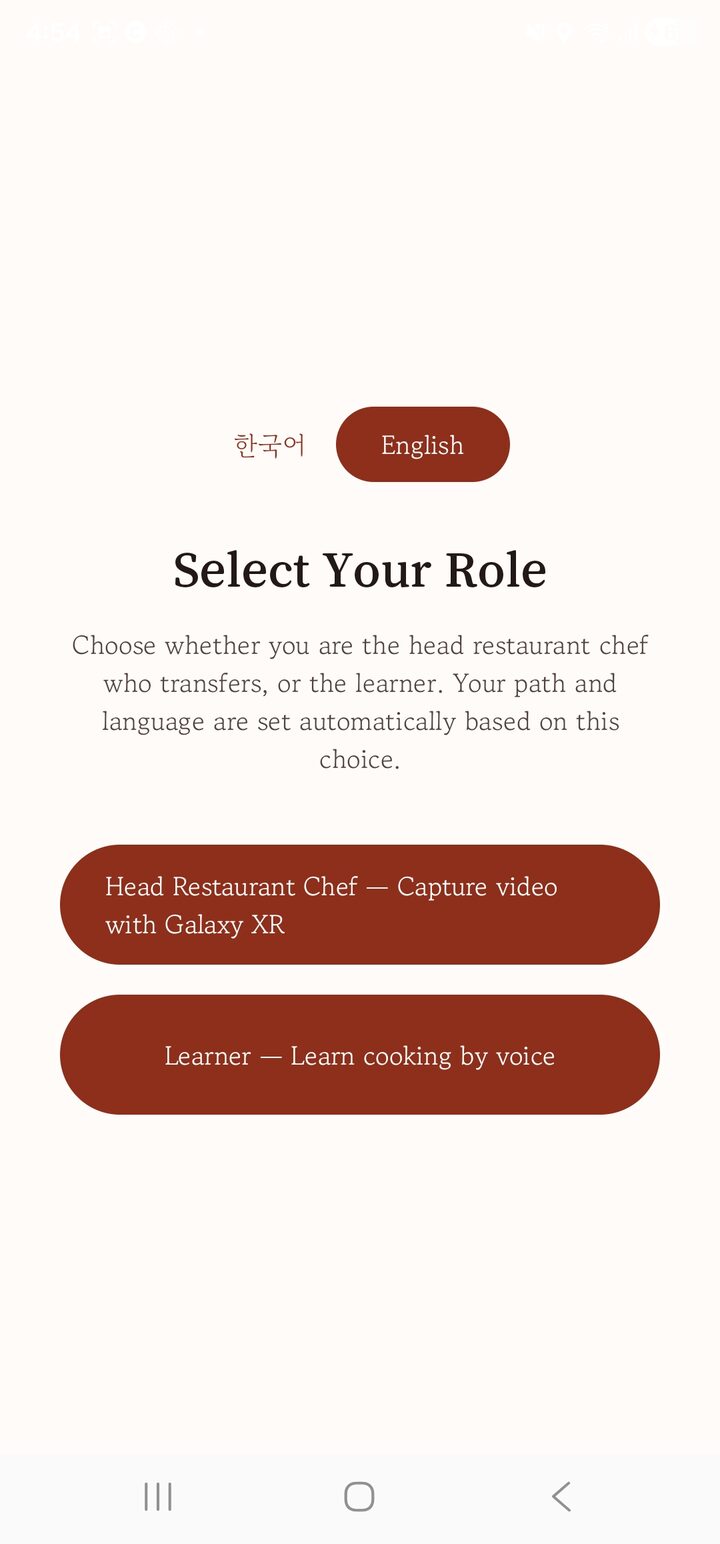
On-device vision AI

AI that spots objects in the cooking scene in real time (the detector) and follows them without losing track (the tracker). We finished developing it all the way through quantization and hardware acceleration so it runs fast on the device itself, and we have ported it to Galaxy XR.

AR guidance overlay

On Galaxy XR, we built an AR overlay that places the AI's guidance exactly over the real spots in the learner's view. We also confirmed in actual rendering that the markers stay world-locked, holding their place even when the learner turns their head.

System framework

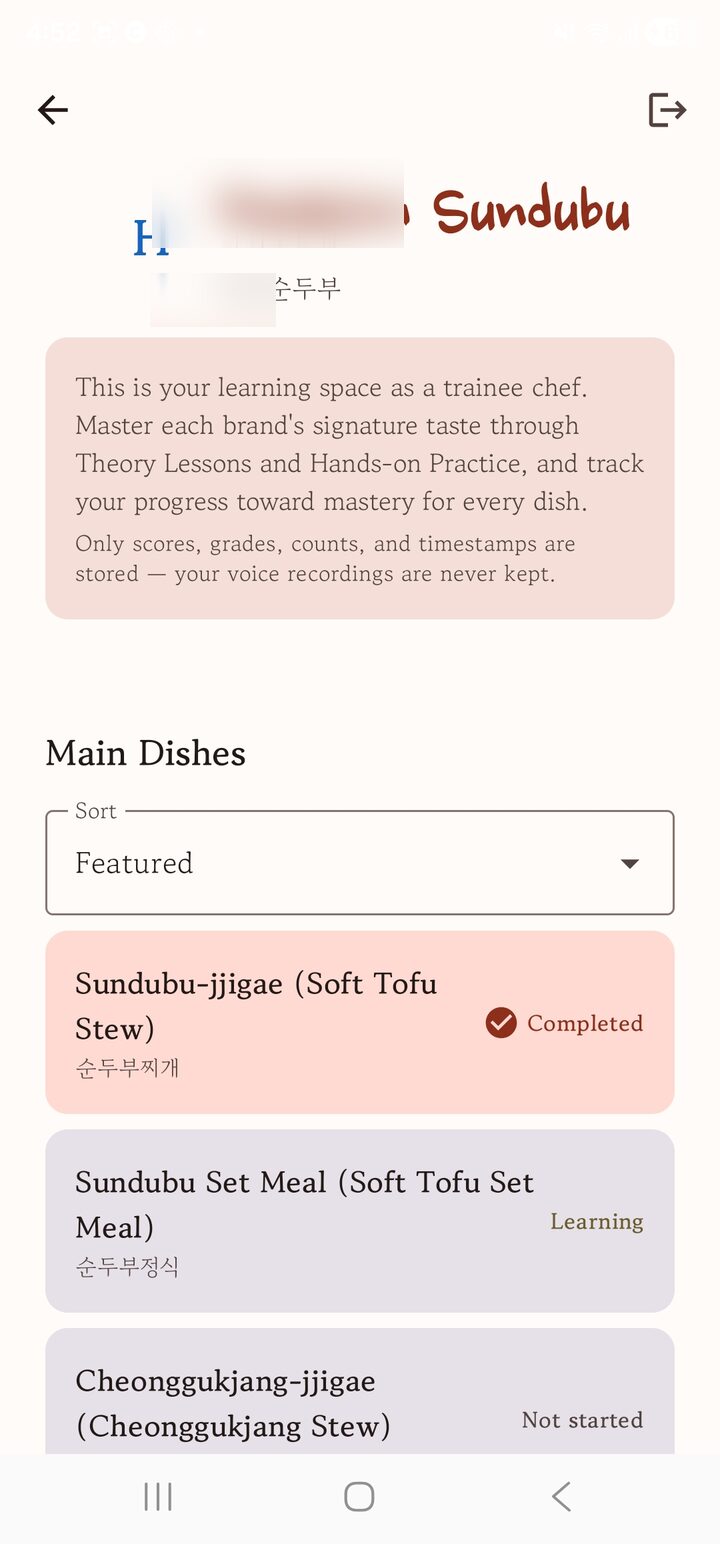
The head restaurant and learner apps, the backend server and the operator's admin system are built out in detail so they work together the way real AI teaching flows. We have also confirmed that teaching, scoring and filming data actually travel between the apps and the server and are saved and retrieved.

Teaching and assessment

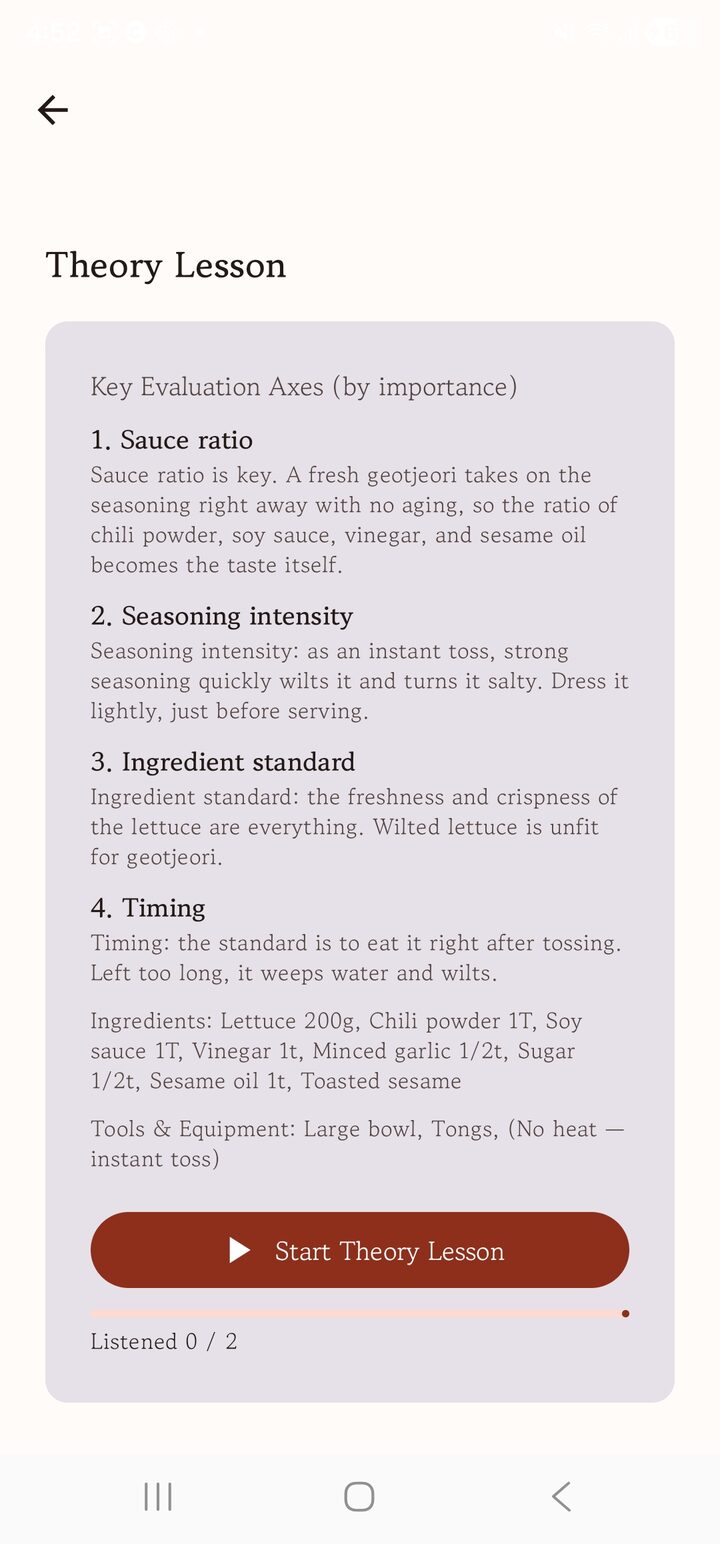
Theory lessons (course material, comprehension checks, pass criteria) and practical assessment (multi-axis deviation scoring, a scoring rubric and a record of why each score was given) now run as a working system on real data. The intelligence that makes those judgments reaches real-world strength once the cloud AI connection below is in place.

Privacy by design

A head restaurant's original footage is encrypted and kept in the cloud only temporarily for training, then deleted automatically once training is done. We designed the data flow so the original is never stored permanently anywhere and only what training needs is kept.

Cloud training and teaching pipeline

We have finished designing and wiring the pipeline: a high-intelligence general AI from big tech learns a head restaurant chef's cooking, then teaches by conversation while seeing the learner's live view through Galaxy XR. Live operation starts together with training on head restaurant footage.

Splitting the work in real time

Seeing and tracking, where response speed is everything, are handled instantly by the vision AI on the device, while deeper understanding and conversation are left to the general AI in the cloud. The work is split between on-device and cloud AI, and the two run together.

In progress

Going live with the cloud AI

What's left is switching teaching conversations and scoring decisions over to the real intelligence of the cloud's general AI. Every part is ready up to the connection point, and the system is designed so that once the link is switched on, all of it runs on real-world intelligence.

Galaxy XR wear testing and refinement

We keep wear-testing the actual headset, refining details such as eye-gaze recognition and judging accuracy while it's worn, based on how it actually feels in use.

Next steps

Training on head restaurant footage

We organize the cooking footage of partner head restaurants and train the AI on it.

On-site device testing

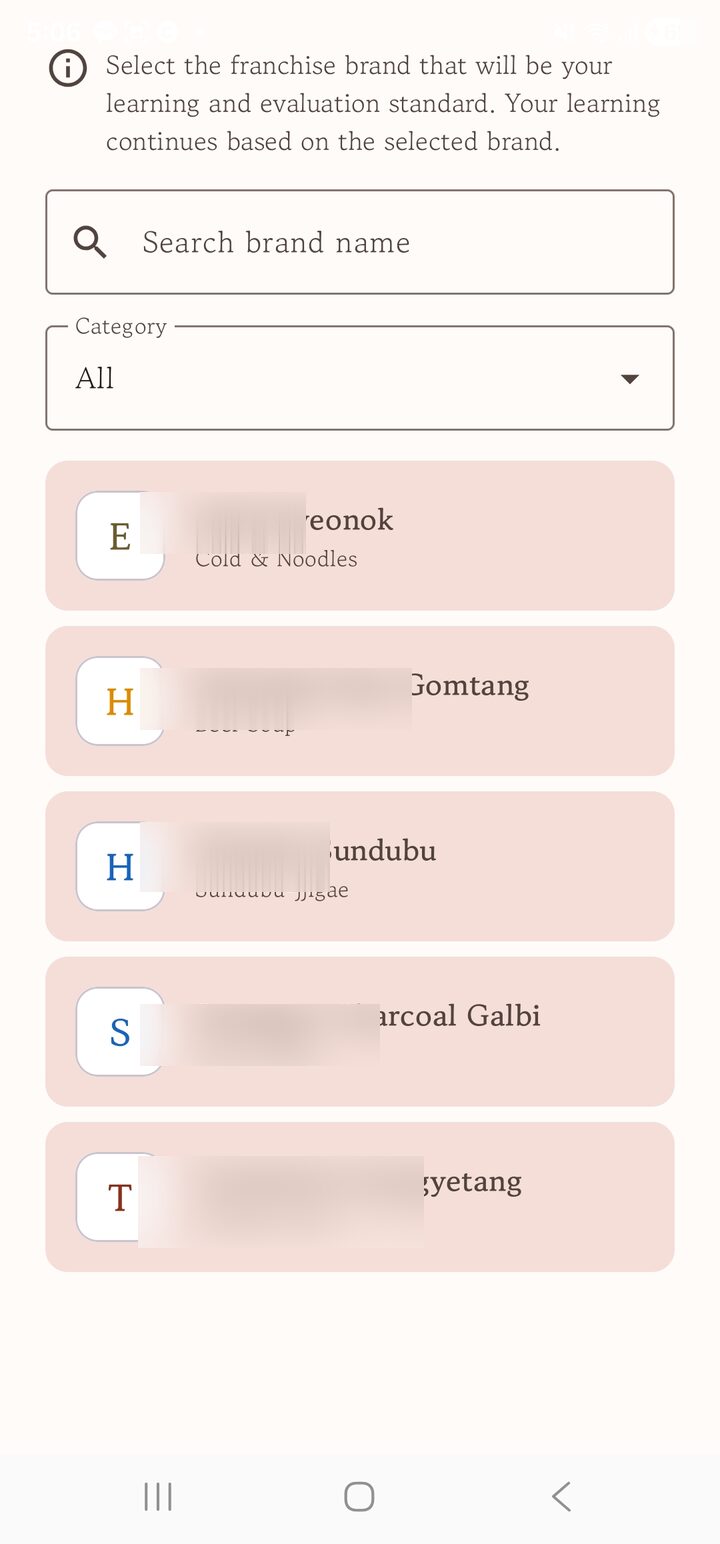
We test the whole process a learner (a franchisee or a franchise's head cook) goes through, in a real kitchen.

Lighter devices

Galaxy XR is well balanced enough for learning to cook and gives a good view while worn, but for even greater comfort we plan to move step by step to smart glasses.

02 Vision & Technical Moat

The technology this cooking AI needs lines up with where the whole industry is heading. That means this isn't a business rowing against a headwind. It's one we can achieve with a powerful current at our back.

01

The world is racing in the same direction

An AI that sees what you see in real time and helps you by talking through whatever is in front of you. Cooking isn't the only field that needs this. Healthcare, manufacturing, education and many other industries want the very same thing.

That's why two things are happening at once. Big tech is betting everything on on-device AI, which runs instantly inside the device rather than over the internet. And giants such as Meta, Samsung and Google are racing to release devices that share your view: smart glasses.

Head restaurant model Match 96 · A Richness 92 Low heat · 96°C Next: skim off the rising foam and fat evenly
AI trained on a head restaurant coaches a franchise cook through retraining, live, right in their view (concept illustration, in development)

What's happening in the industry right now

Sharing what you see: smart glasses

Meta Ray-Ban 2025: 0M+ units sold
Samsung · Google Android XR glasses, fall 2026
Apple Vision Pro on sale · glasses in the works

On-device AI: AI inside the device

Google Gemini Nano · real-time voice (Live)
Apple Apple Intelligence (on-device)
Meta · MS · Nvidia · OpenAI a steady stream of lightweight on-device models
02

Tailoring a general AI to a purpose is already standard practice

Just as we train an AI on one head restaurant's cooking to create an AI for that head restaurant alone, companies around the world take high-intelligence general AIs such as GPT, Gemini and Claude and refine them into versions built for their own purposes (fine-tuning).

In other words, we are building on a proven method, tuning the AI to the signature cooking of Korea's head restaurants.

03

AI already understands cooking in depth

Today's high-intelligence general AIs already have vast knowledge of cooking and real insight into it. We aren't teaching cooking to an AI that knows nothing. We're adding one head restaurant's own recipes and touch to an AI that already understands cooking.

That's a completely different starting point from training from scratch. Because we add one head restaurant's character on top of that deep understanding, the AI can pass on cooking in depth even with relatively little data.

04

AI now builds software

On coding skill alone, some AI models already perform beyond the level of senior developers. More importantly, a human developer usually stands out only in their own specialty, while AI does well across every area. It is also improving literally by the day, so fast that the industry has even begun to worry about it.

We are developing our cooking AI with coding-focused AI as well, and in the near future we will finish a complete version that can go straight into real kitchens as soon as we have the cooking data to train it on.

03 Teaching Beyond Human Limits

We aren't aiming for an AI that merely imitates the head restaurant's chef. When it comes to teaching cooking, our goal is to go far beyond that chef.

Cooking and teaching are different skills

Let us be clear about one thing: no one can match the head restaurant chef's cooking itself. The only area we aim to go beyond is teaching, and that is exactly where AI fills the gap and then goes further.

Same one-on-one lesson: what's the difference?

Head restaurant chef “That pot, over there…” Words only Cooking AI this pot 78°C 3:00 Marks it + shows numbers

Cooking well, and teaching well

Turning out a dish with skill that has become second nature and explaining that know-how so someone else can follow it are entirely different abilities. Our cooking AI focuses on teaching itself, working out where a learner gets confused and what they are missing.

Tireless, for every single learner

Even one-on-one, a person only has so much energy and time. AI teaches every learner whenever they need it, as many times as they need, always to the same standard.

Pointed out in view, shown in numbers

A person can only point with words, like 'that pot over there.' AI marks the exact object in the learner's view and shows in numbers what used to be judged by eye, such as heat level, simmering time and thickness.

Matching down to the finest detail, in real time

Cooking is so subtle that one or two changes can alter the taste. Even learning one-on-one at the chef's side, it's hard to get it just right. Our cooking AI remembers the head restaurant's cooking pattern, checks in real time that the learner's movements match it and closes even the smallest gaps. A person catches the big differences but rarely every detail. AI doesn't miss them.

And the performance keeps improving

How deeply the AI can teach grows with the high-intelligence general AI underneath it. Each time a more powerful fine-tunable model arrives, we'll adopt it to raise performance. We expect to reach our goal, teaching far beyond the head restaurant chef's own ability to pass on their cooking, with models that come well before the so-called AGI era.

Teaching ▲ Model progress · time → Chef's teaching skill AGI era (far future) Target reached near future reached well before AGI

04 Technology Protected by Patent

Protecting the technology

The core technology of our cooking AI is protected by patent: the AI learns a head restaurant's signature cooking as its standard, then compares and passes it on in the kitchen in real time.

01

A chef's touch, turned into a digital standard

When the AI learns a head restaurant chef's cooking from the chef's point of view, a touch words can't fully capture becomes a usable digital standard. Subtle elements of Korean cooking such as heat, broth richness, seasoning, fermentation and aging turn from scattered instincts into clear standards. This conversion itself is protected by the patent.

02

Compared on the spot, in real time

The learner's movements are compared with the head restaurant's standard on the spot, and the next step is pointed out right in their view. Instead of a one-time lesson, the way the cooking is passed on becomes objective in itself, and that is what the patent protects.

03

Judging Korean food on its own terms

We have put numbers to the elements unique to Korean cooking, ones a Western yardstick can't capture, and brought them together in a single system. This framework for judging Korean food by its own standards is also part of the patent.

Learning the chef's cooking Heat Richness Season·ferment AI standard model a digital standard for the taste Patent Learner compared on the spot → score and next-step feedback

05 A Solidly Built System

Our cooking AI and the system around it aren't a prototype made for show or a minimum viable product (MVP). So that learners can genuinely learn to cook, we put a great deal of time and care into the groundwork from the design stage and built it up one step at a time.

0 principles Software principles applied across the whole design

Built not to break, yet easy to change

01

Modular design

The system is split into independent parts such as sign-in, video, security and AI. Changing one part doesn't disturb the others, the way a car's engine and wheels are built separately.

02

Interface abstraction

Parts connect only through agreed connection points. Swap the video input entirely, say from today's XR device to smart glasses later, and the rest of the app keeps working.

03

Extension points

Open slots for a stronger AI or a new device are planned in at the design stage, so there is no need to rebuild from scratch when they arrive.

04

Parameterization

Values that can change, such as security strength or scoring thresholds, live in outside settings rather than deep inside the code, so they can be adjusted without touching the code.

05

Encapsulation

A head restaurant's core data is kept only inside a vault-like 'capsule,' and instead of the original, only the essential features are handled, through set channels.

We kept to these five principles for one reason: to build a structure ready for the technology of the future. When a more powerful AI or a new device comes along, we can swap in just the parts that need changing and carry on right away, without tearing up the core.

Protecting head restaurant recipes

Recipe assets, wrapped in layers of security

A head restaurant's recipes and signature cooking are assets nothing can replace. So we put them at the center and wrapped them in several layers of security. The inner layers protect what is closest to the original, and the outer layers stop outside threats first. We have also left room to add top-level security on top as the company grows.

Inside → outside: five layers of defense

  • Kept briefly, then deleted automatically
  • Encrypted in transit and in storage
  • Kept isolated in Korea
  • Sign-in, permissions and access logs
  • Blocking attacks, with ongoing checks

Head restaurant footage used for training is kept only temporarily and deleted after use. The original is never stored permanently.

06 Tech Terms, in Plain Words

(AR) overlay
Showing the AI's guidance (the next move, a position, a score and so on) in exactly the right spot over the real cooking scene.
Galaxy XR / XR
Samsung's XR (extended reality) headset. You wear it like glasses or goggles, and it layers information over what you see. Learning in the kitchen happens here.
On-device AI
AI that runs inside a smartphone or XR device rather than on an internet server, so it responds instantly, even if the connection drops.
Detector
AI that finds what is where in the picture (for example, where the pot, the ingredients and the hands are).
Tracker
AI that keeps following the same object without losing it, even as it moves.
Quantization
Shrinking a heavy AI while keeping it accurate, so it runs fast even on a small device.
NPU acceleration
Running AI on the device's dedicated AI chip (the NPU), which saves a great deal of time and power. It is practically a must for real-time processing on the device.
Fine-tuning
Further training a widely used general-purpose AI on one field's material to shape it for that field (for example, one head restaurant's cooking).

Why is the overlay the hardest part?

While hands and ingredients move nonstop in front of you, the detector has to find each object accurately and the tracker has to follow it without losing it. Only then can the guidance be placed in exactly the right spot on top. Even a slight delay or offset gets in the way of learning. And because all of this has to happen in real time inside the device (on-device), not on a server, quantization and NPU acceleration are key.